Does the Las Vegas Valley Water District Add Fluoride to Tap Water?
If you live in the Las Vegas Valley, it can be hard to tell whether fluoride is added by the utility, occurs naturally in the source water, or comes from a home filter. The practical answer is that LVVWD customers generally receive fluoridated municipal water through the regional supply system. Here’s how to confirm your provider and understand what the water reports say.
Does the Las Vegas Valley Water District add fluoride?
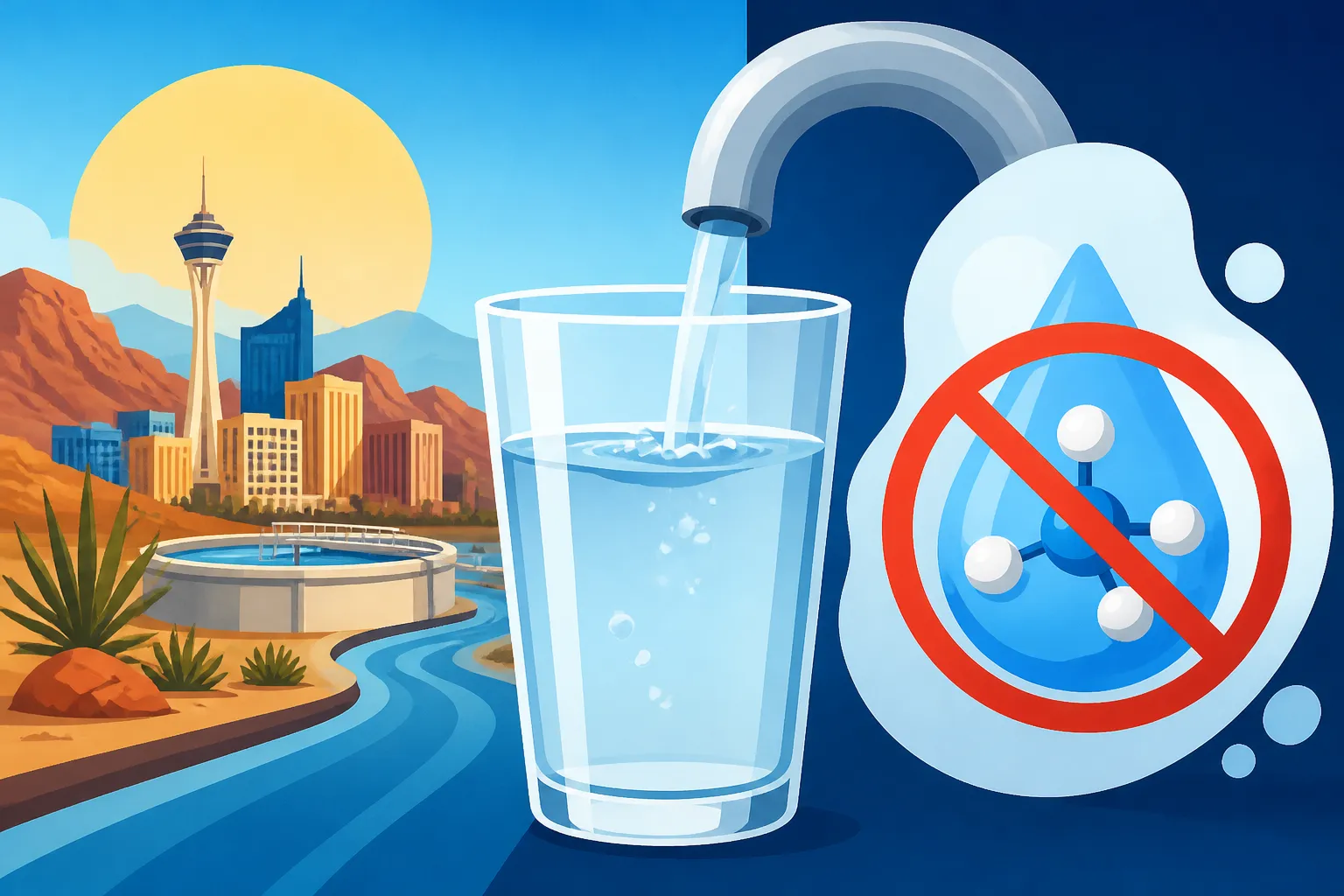
For customers served by the Las Vegas Valley Water District, the practical answer is yes: fluoride is added to the regional treated water supply delivered across much of the valley. The treatment step is handled by the Southern Nevada Water Authority, which treats and supplies water to local retail providers. LVVWD delivers water to customers in its service area.
That distinction matters. The question is often phrased as whether LVVWD “adds” fluoride, but water treatment and retail delivery are separate jobs. The water reaching an LVVWD home may have been treated before it entered the district’s distribution system. So, a customer can receive fluoridated water even if the retail district is not the entity operating the treatment plant.
Fluoride can also occur naturally in water. The amount in a customer’s tap may reflect both treatment practices and the characteristics of the water sources being used and blended. It is not safe to assume that every sample from every tap will show precisely the same concentration.
| Question | Practical answer | What to check |
|---|---|---|
| Does LVVWD service generally include added fluoride? | Yes, customers generally receive fluoridated regional municipal water. | The latest utility water quality report and any current provider notices |
| Does LVVWD necessarily add it at the customer’s neighborhood? | No. Fluoride may be added during regional treatment before water is delivered to the retail provider. | The report’s treatment or water-source notes |
| Is all fluoride necessarily added? | No. Some may occur naturally, and source water can vary. | Reported fluoride range, average, and source information |
| Does a report guarantee the exact amount at one kitchen tap today? | No. A report summarizes monitoring data and may not represent a specific tap or moment. | Ask the provider how to interpret its results or arrange a suitable test |
If you are not sure which company supplies your home, start with your bill or ask the property manager. A building’s water and sewer billing arrangement can be different from the identity of the water supplier. The steps in Finding Your Retail Drinking Water Provider in Nevada can help you sort out who serves your address.
The regional and retail roles are part of a broader system of source water, treatment, storage, and delivery. Understanding Nevada Tap Water Sources, Delivery, and Purity explains how those stages fit together. For a broader overview of what municipal water reports can and cannot establish, see Nevada Municipal Tap Water Quality: Reports and Standards.
What the reported fluoride level does and does not tell you
A utility report is the best starting point for understanding the water supplied to a service area. It can tell you whether fluoride was monitored, what the reported results were, and how those results compare with applicable drinking water standards. It does not necessarily show the exact concentration at your faucet at the time you read the report.
The Southern Nevada regional supply has used a fluoride target around 0.7 milligrams per liter. That figure is a treatment target, not a promise that every tap sample will measure exactly 0.7 mg/L. A report may show a range, an average, or another summary of results, and the values can vary with source water and operating conditions. Check the current report for the reported values and the period they cover rather than treating a past figure as a measurement of today’s water.
The units may look different across documents. Milligrams per liter and parts per million are commonly used for water concentrations; for dilute water solutions, they are approximately equivalent. If a report lists fluoride in one of those units, compare the reported value with the same unit in any other document. Avoid comparing numbers without checking whether they refer to the same measurement unit and reporting period.
A treatment target is not the same as a tap test
A treatment target describes what an operator aims to maintain in the treated supply. A sample from a home faucet reflects what was collected at that location and time. Those are related, but not identical, pieces of information.
A result can be affected by where the sample was collected, whether it came from a distribution-system monitoring point or a household tap, how long water had been sitting in the plumbing, and how the laboratory handled and analyzed it. If you need a result for a specific reason, first clarify whether you need a system-wide report or a test of your own tap.
A household test is not automatically more useful simply because it is more local. The test method must be appropriate for fluoride, and the sample must be collected and handled as the laboratory instructs. If you need a test for a particular decision, ask a qualified lab what sample type and reporting limits it can provide.
Annual reports summarize a defined period
A consumer confidence report, also called a water quality report, generally summarizes monitoring for a defined period. It is useful for understanding the utility’s reported water quality, but it is not a continuous readout of each home’s tap.
Look for the reporting year, the fluoride entry, the units, and whether the result is shown as an average, a range, or another statistic. If fluoride is not easy to locate, search the report for “fluoride” or contact the provider through its official website. The report may list a result without explaining the regional treatment arrangement in detail.
Guide to Tap Water Consumer Confidence Reports Across Nevada explains how to navigate these reports and find the information that matters. If you want to see how local fluoride measurements are discussed across different providers, Checking Fluoride Concentrations in Nevada Municipal Water Supplies is a useful companion.
How to confirm who serves your home and what the latest report says
Before interpreting a fluoride result, make sure you are looking at the right water provider. The Las Vegas Valley includes multiple retail water providers and service areas. A mailing address, city name, or property listing does not always identify the company that supplies the tap.
Use a recent water bill, the provider’s official service-area information, or a direct inquiry to confirm the supplier. If you rent, ask the property manager or owner which provider serves the building; a landlord’s billing arrangement may not make the supplier obvious. For a condominium or apartment complex, confirm whether the building is served directly by a retail utility or receives water through a larger property account.
Once you know the provider, use this process:
- Find the provider’s latest consumer confidence report on its official website.
- Check that the report covers the right service area and the most recent reporting period available.
- Search for the fluoride entry and note its units, reported value or range, and any explanation of source water or treatment.
- Read the report’s notes about sampling and reporting. A result may describe treated water or a system-wide monitoring program rather than a specific household tap.
- If the report leaves an important question unanswered, contact the provider using the current contact details on its official website.
The title of a report can be confusing if a regional supplier treats the water while a local district bills the customer. In that case, the retail provider’s report may discuss water supplied from regional treatment facilities. The name on your bill still matters: it tells you which provider is responsible for customer information and which report is relevant to your service area.
For help locating the right report, see How to Look Up Your Municipal Water Provider and CCR Report. Finding Local Drinking Water Reports on the BSDW Website can also help when you want to compare a provider’s report with state-level public water information.
If your question is whether the report reflects fluoride at your own faucet, ask the provider what its monitoring data represent. If the question requires a home measurement, ask a qualified laboratory whether it offers fluoride testing and what sampling instructions apply. A result from an unrelated test panel, a generic mail-in kit, or an internet map should not be treated as a confirmed reading at your tap.
Do home filters or softeners remove fluoride?
Some home treatment technologies are designed to reduce fluoride, but many common filters are not. The word “filter” by itself does not tell you what a device can reduce. Check the exact model’s performance claims and certification, and match them to the contaminant you want to address.
| Treatment type | What to know about fluoride | What to verify |
|---|---|---|
| Reverse osmosis | Some systems are designed and certified to reduce fluoride. Performance depends on the specific model and operating conditions. | A fluoride-reduction claim for the exact unit, its certification, and its maintenance instructions |
| Distillation | Distillation can reduce many dissolved substances, including fluoride, when the equipment is properly designed and maintained. | The manufacturer’s specific fluoride claim and the unit’s operating requirements |
| Activated carbon pitcher or faucet filter | Many are mainly intended for taste, odor, or selected contaminants; do not assume they reduce fluoride. | Whether the exact model lists fluoride reduction and what certification supports the claim |
| Water softener | A conventional ion-exchange softener is designed mainly to address hardness minerals, not to provide fluoride reduction. | The system’s documented treatment purpose; do not treat softening as fluoride removal |
| Sediment filter | It removes particles within its design range; dissolved fluoride is not a particle. | The stated contaminant reduction claim, not just a micron rating |
For a reverse osmosis unit, look for a specific fluoride-reduction claim and check whether it is backed by an applicable third-party certification. NSF/ANSI 58 is associated with reverse osmosis systems, but the standard number alone does not prove that a particular model is certified for fluoride reduction. Confirm the exact product listing and the specific claim. NSF Health Standards for Filtering Contaminants at Taps explains why certification details matter.
A carbon filter may improve taste or reduce certain listed contaminants without reducing dissolved fluoride. Likewise, a sediment filter can capture particles but is not a substitute for a treatment step designed for dissolved compounds. A label that says “multi-stage” or “advanced filtration” does not, by itself, establish fluoride performance.
If you already have a treatment system, check its manual and replacement schedule. A system can lose performance if filters or membranes are overdue for service, installed incorrectly, or used outside the conditions specified by the manufacturer. Keep the product documentation, note the model number, and verify that replacement parts are intended for that model.
For help comparing treatment types by purpose, Softener, Filter, or RO? Choosing Home Treatment in Nevada offers a broader decision framework. How to Confirm a Nevada Filter Cuts Target Pollutants explains how to check a product’s precise contaminant claim rather than relying on broad marketing language.
Before buying equipment, decide what problem you are trying to solve. If your concern is fluoride specifically, verify that the unit is designed and certified to reduce fluoride. If your concern is taste, hardness, lead, or another contaminant, the right treatment may be different. A device that reduces one substance should not be assumed to reduce others.
When your water source or situation is different
The answer above applies to municipal water delivered to LVVWD customers in the regional supply context. It may not describe every property in Nevada or every tap connected to a private or separate water system.
Private wells are not covered by a municipal report
A private well does not receive water through the LVVWD retail system, so the district’s report cannot establish the fluoride level in that well. Groundwater chemistry varies by location, and naturally occurring fluoride may be present. Well owners need testing designed for their own source and should use a qualified laboratory when a reliable result is important.
Do not use a nearby municipal report as a substitute for a private-well test. Even wells in the same general area can have different water chemistry. The guidance in Testing Nevada Well Water Before Choosing Home Filtration can help owners think through testing before selecting treatment.
Bottled water is a separate product
Bottled water is not necessarily the same as municipal tap water. Its source and treatment depend on the product, and fluoride information may appear on the label or in the company’s product information. If you are comparing bottled water with tap water, check the specific product rather than assuming all bottled water has the same fluoride content.
Rental and shared buildings can complicate the question
In an apartment, the property may receive water from a municipal provider, but the plumbing inside the building can add another layer between the utility and your faucet. That does not mean fluoride is necessarily changed by the building plumbing. It means the utility report describes the supplied system, while a test taken at a particular tap describes that sample.
If you are renting, begin by confirming the water provider and asking the property manager for relevant building information. For concerns about plumbing-related contaminants, a test should be selected for the contaminant and question at hand. Fluoride and lead, for example, are different questions and may require different sampling approaches.
Medical or personal decisions need qualified advice
People may have personal questions about fluoride intake, dental care, infant feeding, or a medical condition. A water report can tell you what the provider reports about the water; it cannot determine what is appropriate for an individual. Ask a medical professional or your local health department for advice about health effects or personal decisions.
If a treatment system is being considered for a health-related reason, discuss the result and the proposed equipment with an appropriate professional. Verify the system’s exact contaminant claim and certification against the water test or utility data relevant to your situation. Treatment selection should not rely on a vague label or an assumption that all water filters work alike.
Frequently Asked Questions
Is fluoride added directly by LVVWD?
Customers generally receive fluoridated municipal water through the regional supply system. Fluoride is added during regional treatment by the Southern Nevada Water Authority, while LVVWD delivers water to customers in its service area.
Is the fluoride level exactly the same at every Las Vegas tap?
No. A regional treatment target is not a guarantee that every tap sample will have an identical measurement. Source water, blending, sampling location, and the time of sampling can affect reported results.
Where can I find the fluoride result for my home?
Confirm your retail water provider, then check its latest consumer confidence report on the provider’s official website. The report describes the reporting period and measurements; contact the provider if you need help interpreting them.
Will a standard pitcher filter remove fluoride?
Do not assume so. Check the exact model’s documentation for a fluoride-reduction claim and supporting certification. Many filters are designed for other purposes, such as taste or selected contaminants.
Does a water softener remove fluoride?
A conventional softener is designed primarily to address hardness minerals, not fluoride. If fluoride reduction is your goal, choose a treatment system with a specific, verified fluoride-reduction claim.
Disclaimer
This article is for general informational purposes only and does not constitute professional advice. Laws, prices and regulations vary by location and change over time. Consult a qualified professional for guidance on your specific situation. Nevada Water Guide is not a government agency or water utility and is not affiliated with any public water system.