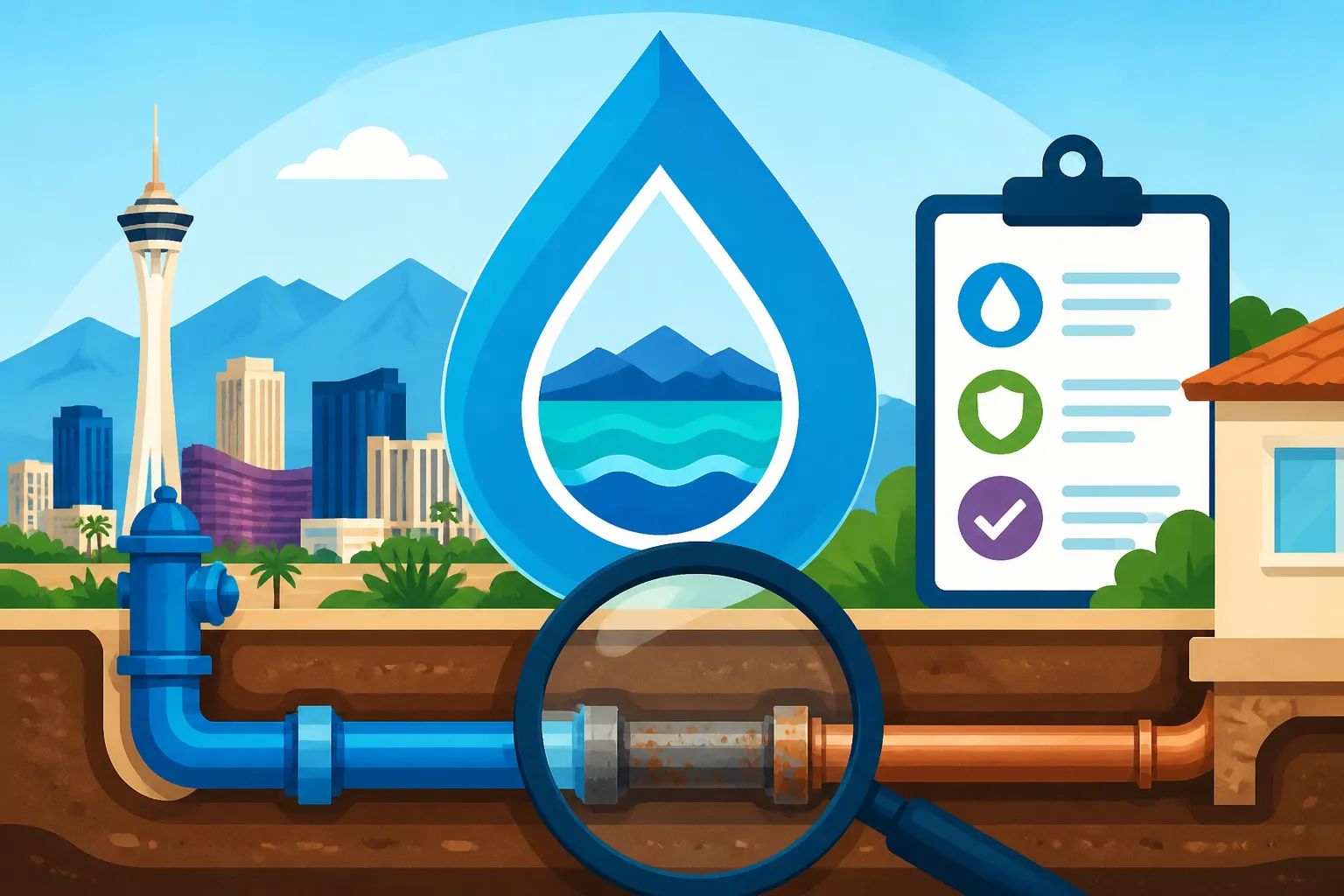
Las Vegas Valley Water District Service Line Inventory Results
The Las Vegas Valley Water District’s service line inventory helps answer whether lead pipes connect homes to the public water system. Its headline result is reassuring, but an inventory is not a plumbing inspection: records may be incomplete, and pipes inside a home are a separate concern. Here’s what the result can tell you, how to check an address, and what to do if its status is uncertain.
What the Las Vegas Valley Water District inventory reports
The Las Vegas Valley Water District’s published inventory does not identify known lead service lines in its system. That is useful information for customers concerned about lead in the pipe connecting a home to a water main. It is not, however, a guarantee that every pipe at every address has been physically inspected or that no lead is present in a building’s plumbing.
A service line is the pipe that carries water from a public water main toward a building. Depending on the property and how the system is arranged, the line can include a utility-owned section and a customer-owned section. The inventory records the material of those sections when it can be established, and may identify a section as unknown when records or other evidence are not enough to confirm its material.
That distinction matters when reading the result. “No known lead service lines” describes what the inventory identifies; it should not be interpreted as “every pipe in every home is confirmed lead-free.” A line with an unknown material is not the same as a confirmed lead line, but it is not a confirmed non-lead line either. And the service line is only one part of the route water takes before it reaches a glass.
| Inventory result or pipe location | What it can tell you | What it does not establish |
|---|---|---|
| No known lead service lines reported | The inventory does not identify known lead service lines in the system | That every line has been physically inspected |
| Service line material listed as non-lead | Available records or verification indicate a different material for that segment | That indoor plumbing, fixtures, or solder contain no lead |
| Service line material listed as unknown | The material of a segment has not been confirmed in the inventory | That the pipe is lead or that it is safe to ignore |
| Customer-side plumbing inside a building | Requires separate records, observation, or testing to assess | Its material is not necessarily established by the utility inventory |
The inventory is a system-level record, not a water test for a particular kitchen faucet. It helps a water provider and customers understand where service-line materials are documented and where information gaps remain. It also provides a starting point for follow-up, especially for older properties or buildings whose plumbing history is unclear.
For context on how the inventory fits into broader oversight, see How Nevada Water Systems Must Handle Unverified Service Lines and How NDEP Regulates Lead and Copper in Nevada Public Water Systems. Those topics explain the role of inventory work and state oversight, while an address-level lookup is the practical next step for an individual property.
What a service line inventory covers—and what it leaves out
The term “service line” can sound as if it refers to all the pipes in a home. It does not. The service line is the connection between the public water main and a building’s plumbing. Once water passes the meter or enters the building, it can travel through additional pipes, fittings, valves, and fixtures that are not the service line.
A useful way to picture the route is:
- Water leaves a public water main in the street or nearby right-of-way.
- It travels through the service line toward the property.
- It passes through the meter or other service connection, depending on the layout.
- It enters the building’s plumbing.
- It reaches fixtures such as a kitchen faucet, bathroom tap, or water heater.
The exact division of ownership and responsibility can depend on the system and property arrangement. A utility inventory may distinguish between the utility-owned and customer-owned portions of a service line. It generally does not provide a complete material history for every pipe inside a home, nor does it certify every faucet, connector, or fitting.
Service lines versus indoor plumbing
Indoor plumbing can include copper, plastic, or other pipe materials, along with fittings and solder that may have different compositions. Older plumbing may have parts worth checking even when the service line is listed as non-lead. A service line lookup therefore answers a narrower question than “Does my home have any lead plumbing?”
If a property has a lead service line, that is a significant finding to discuss with the utility. If the service line is non-lead, there may still be reason to review older interior plumbing or to arrange appropriate tap testing. The inventory result does not replace those steps.
For a closer look at household plumbing sources, see How Older Home Plumbing and Solder Release Tap Lead and Checking Pre-1989 Home Plumbing for Copper Pipes With Lead Solder. These are especially relevant when a home has older plumbing, renovations with unclear records, or fixtures that have not been updated.
Inventory status is not the same as a water-quality result
A service line inventory records material information. It is not a laboratory result showing the lead concentration at a specific tap. Tap results can vary with plumbing materials, water-use patterns, sampling method, and the location tested. A utility’s system-wide compliance sampling and a test from a particular home also serve different purposes.
That is why it is useful to keep three questions separate:
- What material is the service line made from?
- What materials are present in the home’s plumbing and fixtures?
- What does a properly collected sample show at the tap?
Each question calls for a different type of information. The inventory can help with the first. A plumber or building records may help assess the second. A suitable laboratory test can address the third.
For details on how these questions relate to public-system monitoring, read Lead and Copper Sampling Plans for Nevada Public Systems and Does Utility Lead Compliance Mean Your Home’s Tap Water Is Safe?. Utility-level compliance is important, but it does not make every property’s plumbing identical.
How to check a specific Las Vegas Valley address
A general inventory result is useful, but homeowners, tenants, and prospective buyers often need an address-specific answer. Use the Las Vegas Valley Water District’s official service-line lookup or inventory information to check the property. Because online tools and records can change, confirm the current status through the District’s official website rather than relying on an old screenshot, a property listing, or a third-party summary.
For step-by-step help with that lookup, see How to Look Up Your Service Line in the Las Vegas Water District Map. If the map or lookup tool does not provide a clear result, contact the District using the current contact details on its official website and ask what information is available for the exact address.
What to have ready
Before checking, gather the property’s full street address, including any unit number. If the property has a recent renovation, service-line replacement, or plumbing inspection record, keep that information nearby. A parcel number can be helpful when an address is new, has changed, or is difficult to match to the utility’s records.
When reviewing the result, look for the status of each segment rather than only the overall label. A property can have one material recorded for the utility-owned section and a different or unknown status for the customer-owned section. If a tool shows a map pin or a short description, open the underlying details if available and note whether the information applies to the full line or only part of it.
Questions to ask if the result is unclear
If the address is missing, marked unknown, or described in a way that is hard to interpret, ask the District:
- Does the result cover both the utility-owned and customer-owned portions?
- Which part of the service line has a confirmed material?
- What evidence supports the listed material?
- Is any part of the line classified as unknown?
- Has the utility updated the record after a repair or replacement?
- What should a customer do if the private-side material cannot be verified?
Write down the answer and the date you received it. If you are buying or renting, ask the owner or seller for any records of prior plumbing work, but treat those as supporting documents rather than substitutes for the utility’s current service-line information.
A map is a record system, not necessarily a photograph of the pipe. Some materials may have been documented from construction records, prior maintenance, or field verification. The method used can affect how confidently a segment is classified. If the District cannot confirm a material, the appropriate interpretation is that the record is incomplete—not that the pipe is automatically lead or automatically safe.
What to do if a line is unknown or the home is older
An unknown service-line status does not prove that lead is present. It does mean the available record does not settle the question. The sensible response is to verify what can be verified, consider the building’s age and plumbing history, and ask about testing if concern remains.
Start with the utility’s address-level record. Then look for property documents, such as plumbing permits, renovation invoices, inspection reports, or records of a service-line replacement. A licensed plumber can help identify accessible pipe materials, although a visual check may not establish the material of buried sections or concealed plumbing. Avoid digging or removing pipe sections yourself to identify a material.
If the District confirms that a service-line segment is unknown, ask whether it has a process for updating records or reviewing customer-provided documentation. The utility can explain what evidence it accepts and whether any field investigation is available. Requirements and procedures can change, so use the District’s official website for current information.
For the regulatory treatment of unknown sections, see How Nevada Water Systems Must Handle Unverified Service Lines. The status is meaningful because it identifies a data gap to resolve; it is not the same classification as a confirmed lead line.
Consider the building’s plumbing separately
Older homes can have plumbing components that deserve attention even when a service line is documented as non-lead. Relevant details include the age of the building, whether plumbing has been replaced, whether original fixtures remain, and whether past renovations were permitted and documented. A plumber can help assess accessible pipes and fittings and explain where visual inspection has limits.
If you are a tenant, ask the owner or property manager whether service-line and plumbing records are available. A tenant may not be able to access buried pipes or authorize repairs, but can still request information and ask the utility about the service-line record for the address. For properties with shared plumbing, such as multi-unit buildings, an individual unit’s plumbing may not tell the whole story of the building’s service connection.
When testing may make sense
If you want information about the water at a specific tap, use a qualified laboratory and follow its instructions for sampling. The correct sampling method depends on the question being asked. A sample collected after flushing can answer a different question from a first-draw sample that has remained in contact with plumbing. Do not improvise a collection method and assume the result is comparable to a utility or laboratory protocol.
Nevada residents can use Finding a Nevada-Certified Lab to Test Tap Water for Lead to understand how to locate a suitable lab. If you are unsure which sample type or collection procedure is appropriate, ask the laboratory or the local health department before collecting. A health department or medical professional is the right source for questions about health effects or individual medical concerns.
Testing does not identify the pipe material, and a pipe-material lookup does not measure the water at a tap. They answer different questions, so testing should be chosen to match the concern rather than treated as a substitute for the service-line record.
What the inventory means for customers and property decisions
For a customer, the inventory is a practical screening tool. It can help determine whether a known lead service line is recorded for an address, whether a segment needs verification, and what follow-up questions are reasonable. It can also help a buyer or renter ask more specific questions before committing to a property.
For a home purchase, request the current service-line status and any records of replacement or plumbing work. Do not rely only on a general statement that the neighborhood has no lead lines. A neighborhood-level result may not answer the status of the specific property, and a public service-line record may not cover interior plumbing. Buyers should also distinguish a water-quality report for the public system from a test collected at the home’s tap.
For a rental, the most useful first step is often to check the address with the District and ask the landlord or property manager about building plumbing records. In multi-unit housing, the service line may serve a whole building, while plumbing inside the building may differ by unit or branch. A single unit’s fixture inspection may not answer whether the shared connection or other building components have been assessed.
For customers dealing with uncertainty, the inventory should make the conversation more precise. Instead of asking only “Is there lead in the water?”, ask whether the utility has confirmed the material of each service-line segment, whether the private-side status is unknown, and how to obtain a tap test if one is appropriate.
Interpreting reassuring results without overreading them
A record showing no known lead service lines is reassuring about the service-line information the District has documented. It is not a reason to assume every pipe in a property has been examined. Likewise, an unknown segment deserves follow-up, but it does not establish that a lead pipe is present.
The useful middle ground is to take the record seriously without asking it to answer questions it was not designed to answer. Check the exact address. Confirm which segments are covered. Consider the home’s plumbing history. Use suitable testing when the question concerns tap water rather than pipe material.
If a service line is confirmed as non-lead but a home has old plumbing, the next steps may focus on interior pipe materials, fixtures, or sampling. If a service line is unknown, follow up with the utility and consider whether records or professional inspection can resolve it. If a lead service line is identified, ask the utility about its current procedures and options; do not assume the inventory alone explains who must arrange or pay for work.
Do not treat boiling as a lead-removal method
Boiling water does not remove lead. Heating can reduce water volume through evaporation and leave dissolved substances more concentrated. If a lead concern exists, use the utility’s advice and suitable testing rather than boiling as a treatment step. For further context, see How Boiling Tap Water Concentrates Rather Than Removes Lead.
Common misunderstandings about the result
Inventory results are easy to oversimplify, especially when a headline is reduced to “no lead pipes.” A more accurate reading keeps the scope, evidence, and remaining unknowns in view.
“No known lead lines” means every line was checked
Not necessarily. A published inventory can report no known lead service lines while still relying partly on records or carrying unknown classifications. Ask whether the address-specific result covers the entire line and whether both ownership segments have confirmed materials.
A non-lead service line means the tap cannot contain lead
No. The inventory focuses on the service line, not every indoor pipe, fitting, solder joint, or fixture. A non-lead service line is one relevant piece of information, not a complete plumbing assessment.
An unknown line is a confirmed lead line
No. Unknown means the material has not been confirmed in the available record. It calls for follow-up, not an assumption in either direction. Ask the utility how it handles unknown records and what documentation could resolve the status.
A system report is the same as a test at my faucet
No. A utility inventory records pipe material. A laboratory sample measures water at a particular place and time under a specified sampling procedure. A system compliance report describes the public water system’s monitoring and results under its program. Each offers different information.
For help reading public reports and understanding what they cover, see Guide to Tap Water Consumer Confidence Reports Across Nevada and Checking Utility Compliance in Nevada Consumer Confidence Reports. These reports provide broader system context, while a specific service-line lookup and tap sample address different property-level questions.
Replacing one part of a line resolves every plumbing concern
Not necessarily. A service-line repair or replacement addresses that connection, but indoor plumbing and fixtures are separate. If work is done, ask what segments were replaced, what materials were used, and whether records were updated. Keep invoices and permits with the property’s maintenance documents.
A practical checklist for reviewing the inventory
Use this checklist to turn the system result into a clear next step:
- Look up the exact address in the Las Vegas Valley Water District’s current official service-line tool or inventory information.
- Record the result and note whether it applies to the utility-owned segment, the customer-owned segment, or both.
- Check for unknown status rather than treating an overall label as a complete answer.
- Ask the District what the record means if the address is missing, unclear, or only partly verified.
- Gather property records for service-line replacement, plumbing renovation, and permits.
- Assess indoor plumbing separately with records or a licensed plumber, especially when the home is older or its plumbing history is uncertain.
- Consider laboratory testing if the question is about water at a particular tap, and follow the lab’s collection instructions.
- Keep the documentation so future owners, tenants, or contractors can understand what has been verified.
The main takeaway is balanced: the District’s published inventory does not identify known lead service lines, but the result is not a certification of every pipe in every building. An address-level check can clarify the service line; records, professional inspection, and appropriate tap testing can address the separate questions the inventory cannot.
Frequently Asked Questions
Does the Las Vegas Valley Water District inventory identify known lead service lines?
The District’s published inventory does not identify known lead service lines. Check the current official inventory for the status at a specific address, including whether any segment is listed as unknown.
Does a non-lead service-line result prove that all home plumbing is lead-free?
No. The inventory concerns the service line, not every pipe, fitting, solder joint, or fixture inside a building. Older or undocumented indoor plumbing may need separate review.
What should I do if my address is marked unknown?
Ask the District what part of the line is unknown, what evidence it has, and whether records or field verification can update the result. An unknown status does not confirm lead, but it also does not confirm a non-lead material.
Is a service-line lookup the same as testing tap water?
No. A lookup identifies recorded pipe materials; a laboratory test measures a water sample collected from a particular tap under a specific procedure. One does not replace the other.
Disclaimer
This article is for general informational purposes only and does not constitute professional advice. Laws, prices and regulations vary by location and change over time. Consult a qualified professional for guidance on your specific situation. Nevada Water Guide is not a government agency or water utility and is not affiliated with any public water system.